
I’ve been working to build a new model for local government that brings policy back to real life and expands the imagination of what a municipality can do for its residents, particularly around childcare, housing, groceries, and utilities. Most people experience government only after decisions are already made, but I believe residents deserve transparency into the actual testing, tradeoffs, and construction of policy, so I’ve been building affordability ideas in public, sharing the data, and showing residents how decisions get made.
Childcare recap: That work has helped drive one of the most ambitious childcare affordability efforts pursued by any municipality in Colorado. We have already recognized childcare as essential infrastructure, established zoning by-right for childcare providers, and embedded affordability into Westminster’s Strategic Plan. I’m advancing additional policy ideas and the community hopes these ideas are prioritized at our Budget Workshop on May 9, including:
1) exempting infant formula from grocery sales tax
2) creating a Westminster Property Tax Incentive Program
3) including childcare providers in future mixed use developments, and
4) exploring donation of vacant city owned land to childcare providers.
Read my previous “Childcare Crisis in Westminster” update here.
But today let’s focus on the housing crisis in Westminster and what we’re doing about it. Like I said, this is a long one, so grab a coffee.
Linda (67 years old), from Kings Mill neighborhood, told me she is living on a fixed income and choosing between groceries and utilities when Xcel raises rates. Last week, representatives from Xcel came before City Council and I directly challenged them on Westminster’s growing energy constraints, rising costs, and the reality that developers are increasingly struggling to build housing and economic projects because our substations are already at maximum capacity. Read this Denver Gazette article with my quotes from that consequential exchange with Xcel.
My challenge to Xcel was important because of the current housing crisis in Westminster.
Mark (34 years old), from the Sheridan Green neighborhood, told me he and his wife are considering leaving Westminster because they cannot find housing large enough for their growing family without doubling their monthly payment. Daniel (29 years old), from Westminster Station, told me he earns too much to qualify for assistance but still cannot realistically afford to buy his first home in the city where he works.
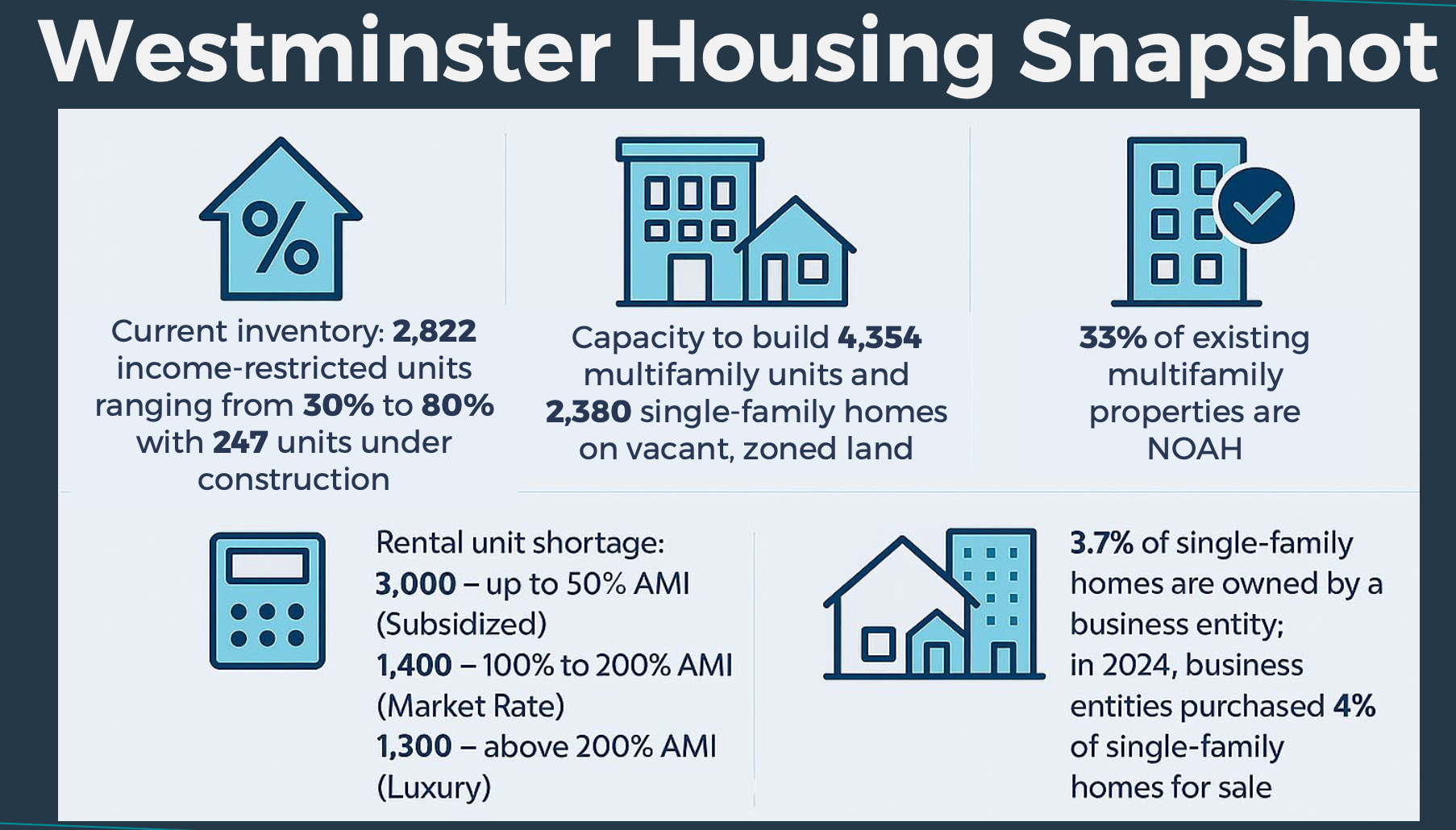
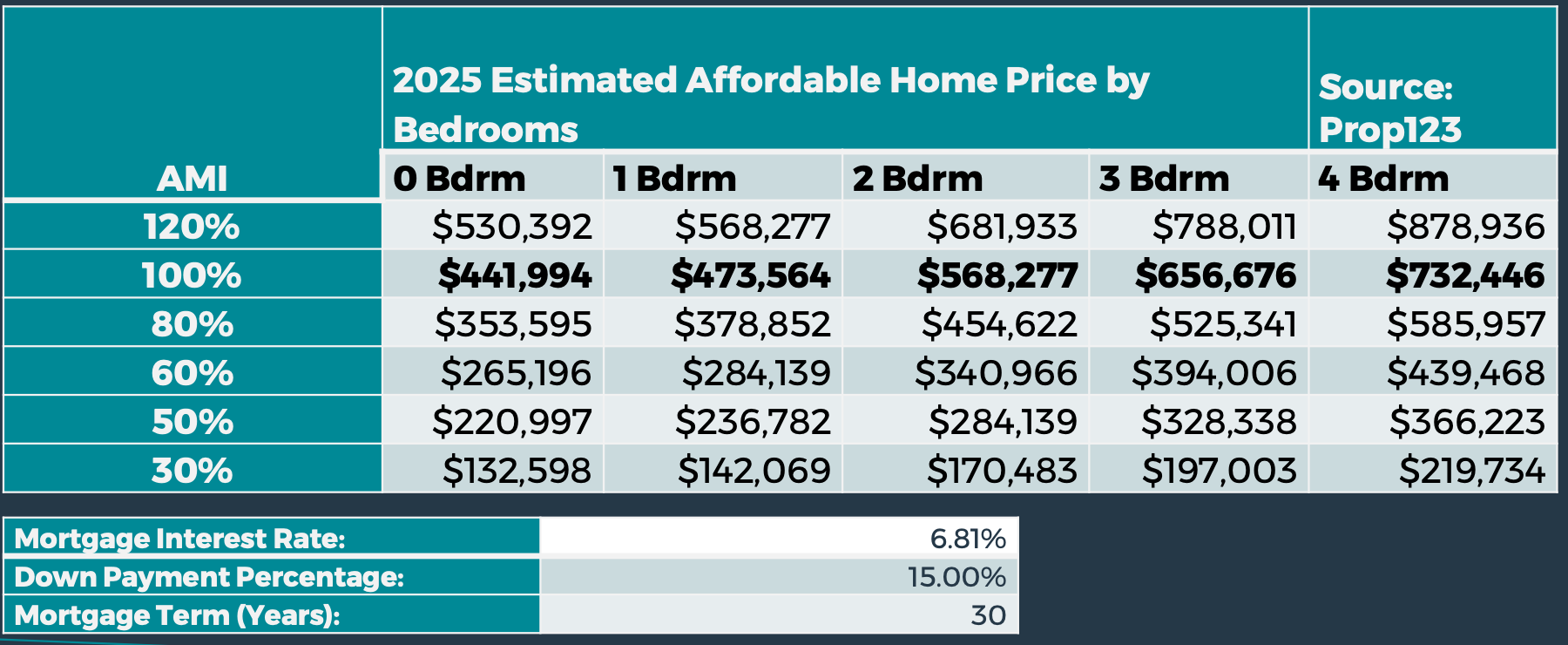
Westminster has a housing shortage and the numbers are becoming increasingly difficult for working families, young professionals, and older adults to navigate. Nearly 33% of Westminster households are housing cost-burdened, meaning they spend more than 30% of their income on housing. An additional 10% of Westminster households are “severely-burdened” spending 50% of their income on housing. Westminster has a 3,000-unit deficit for rental units that serve Area Median Income (AMI) levels between 30 to 50%. First-time home buyers with 120% AMI or below face significant affordability challenges. As a result, many residents are being pushed into increasingly unaffordable rents, overcrowded living situations, deferred homeownership, or housing conditions that do not match the dignity and stability they deserve.
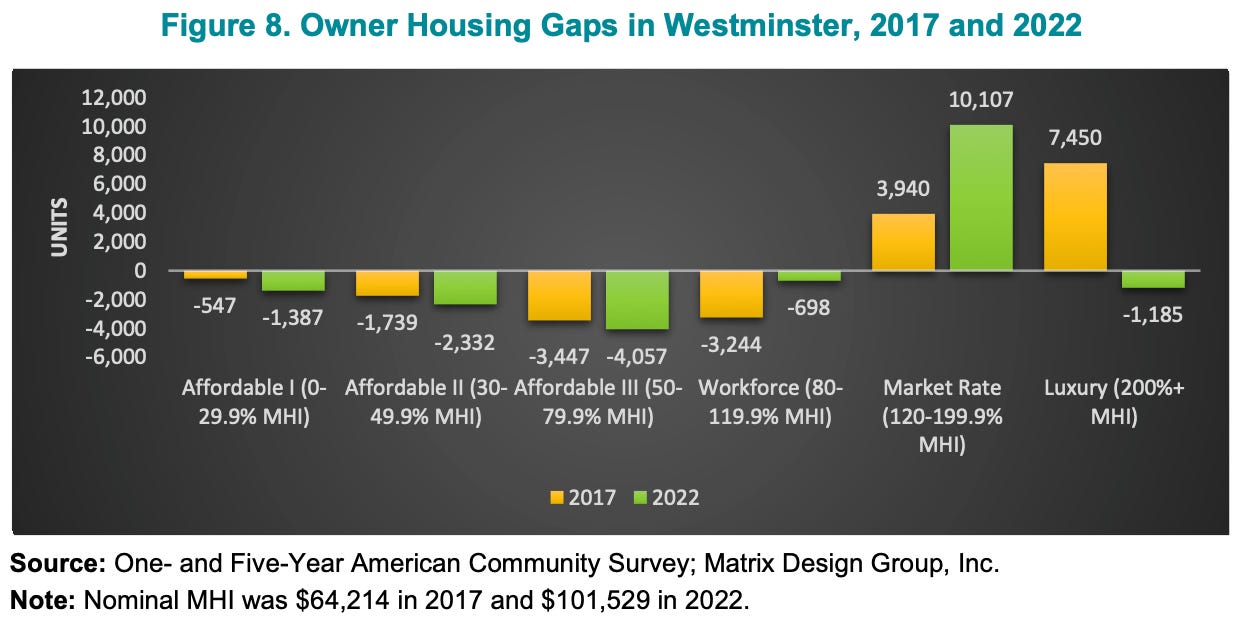
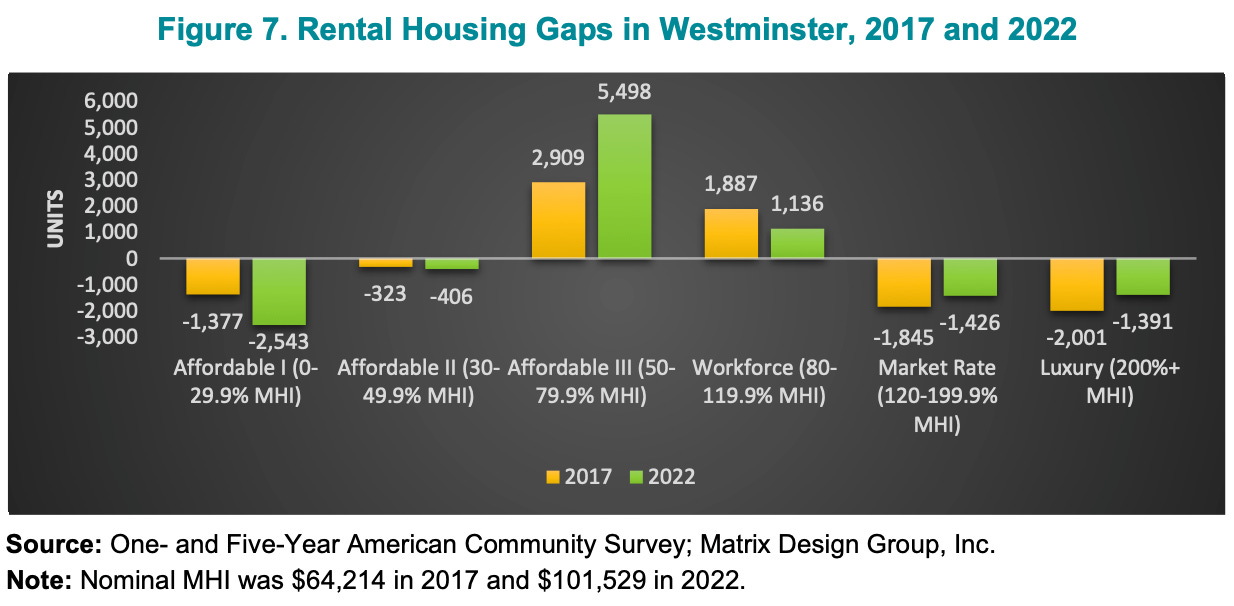
During my re-election (over 100 days ago), I pledged to lower costs in childcare, housing, groceries, and utilities, and regarding housing, I am fighting for inclusive, income-diverse, and income-aligned options that serve people from all walks of life and life stages.
Big Housing wins so far at Westminster City Council:
We have the best staff in the state and they have already worked in partnership to already deliver major wins:
✅ Created a Housing Trust Fund to provide gap financing for the development of income-aligned housing and housing-related programs.
✅ Approved $375,000 for targeted housing stability funding to prevent evictions and keep residents housed. Up to $20,000 per household delivered through fast, accountable payments via the Community Economic Defense Project. In Westminster, ~50% of those in experiencing homelessness are newly unhoused, so the only way to reduce it is to move upstream with preventative solutions like this.
✅ Approved Blossom Commons, a $26 million senior affordable housing project that will add 50 homes for older adults earning 30%–70% AMI, and will be deed restricted for 60 years.
✅ Updated Comprehensive Plan that allows for more diversity of housing types like missing middle and Senior and special needs housing
✅ Standardized Development Assistance to include a predictable sliding scale of rebates for developers who include income-aligned units in their housing projects and establish a sliding scale of rebates for fees such as Public Land Dedication (PLD)
✅ An expedited review process for income-aligned housing projects (almost finalized)
✅ Tiny Homes are now allowed (stay tuned!!)
✅ Accessory Dwelling Units are now allowed and grant funding ($300,000) has been secured for a pilot program
✅ Discontinued Mandatory Official Development Plan (ODP) Reviews of multi-family projects by City Council to save time and money for projects
✅ Discontinued Concept Plan Reviews (CPR) for all housing projects to save time and money
✅ Implemented Right of First Refusal to purchase existing income restricted units in the city to preserve affordable housing stock
✅ Sustained and expanded the Westminster’s affordable housing preservation programs (322 units preserved with $458,000 investment)
✅ Condo defects protection (in our limited capacity vs what the state could do): Westminster is building lots of condos and we recently had one of the first condo projects in the state in at least the last 10-15 years
✅ Removed “Residential Service Commitment Competition” before the State made it illegal
✅ Opted in to Prop 123 expediting intent (CO’s push for affordable housing)
And I have continued to push for even more advancements to support Westminster families during this housing crisis. In Westminster, our Strategic Plan is a formal document that guides everything we do. In the new Strategic Plan that was finalized last month, I successfully prioritized the following housing objective:
Under Strategic Priority 1: Opportunity to Thrive
“1.1 Improve housing stability, affordability, and access, including strengthening pathways to homeownership, preserving owner occupancy, homelessness prevention strategies and supporting renter stability so Westminster residents have a secure and safe home.”
I am also embedding affordability into our current budget planning process:
I’m pushing for these Housing-specific Ideas (Pending prioritization at May 9 Budget Workshop):
Create a Westminster Downpayment Assistance Program for first-time and moderate income homebuyers (Status: TBD):
The test: I’m formally requesting we partner with CHFA as program administrator to pilot a new Westminster-specific down payment assistance program for first-time and moderate income homebuyers using City funds and external grants through revolving loan structures to expand homeownership and reduce displacement risk. CHFA would administer underwriting, compliance, and repayment, while Westminster contributes capital earmarked for Westminster homebuyers within the existing CHFA framework.
The data: TBD prioritization May 9
The decision: TBD
Increase income-aligned and mixed housing supply (Status: TBD):
The test: increase senior affordable housing and address unique needs of an aging population, predictable development assistance programs, reducing development fees and timelines, strategic use of city owned land for donation or discounted resale (to childcare providers, affordable housing providers, grocers) and mixed income neighborhood development strategies
The data: TBD prioritization May 9
The decision: TBD
Evaluate policy reforms to limit short-term rentals, including increased short term rental fees (Status: TBD):
The test: Amend Ordinance No. 4199 to increase license fee to $500 and increase enforcement to minimize impact on local housing.
The data: TBD prioritization May 9
The decision: TBD
Strengthen renter stability and rental housing quality:
The test: Rental inspection expansion, rental housing standards awareness and displacement prevention strategies
The data: TBD prioritization May 9
The decision: TBD
Are corporations pricing families out of housing in Westminster? (Status: Analysis Complete; Further Action Pending Prioritization):
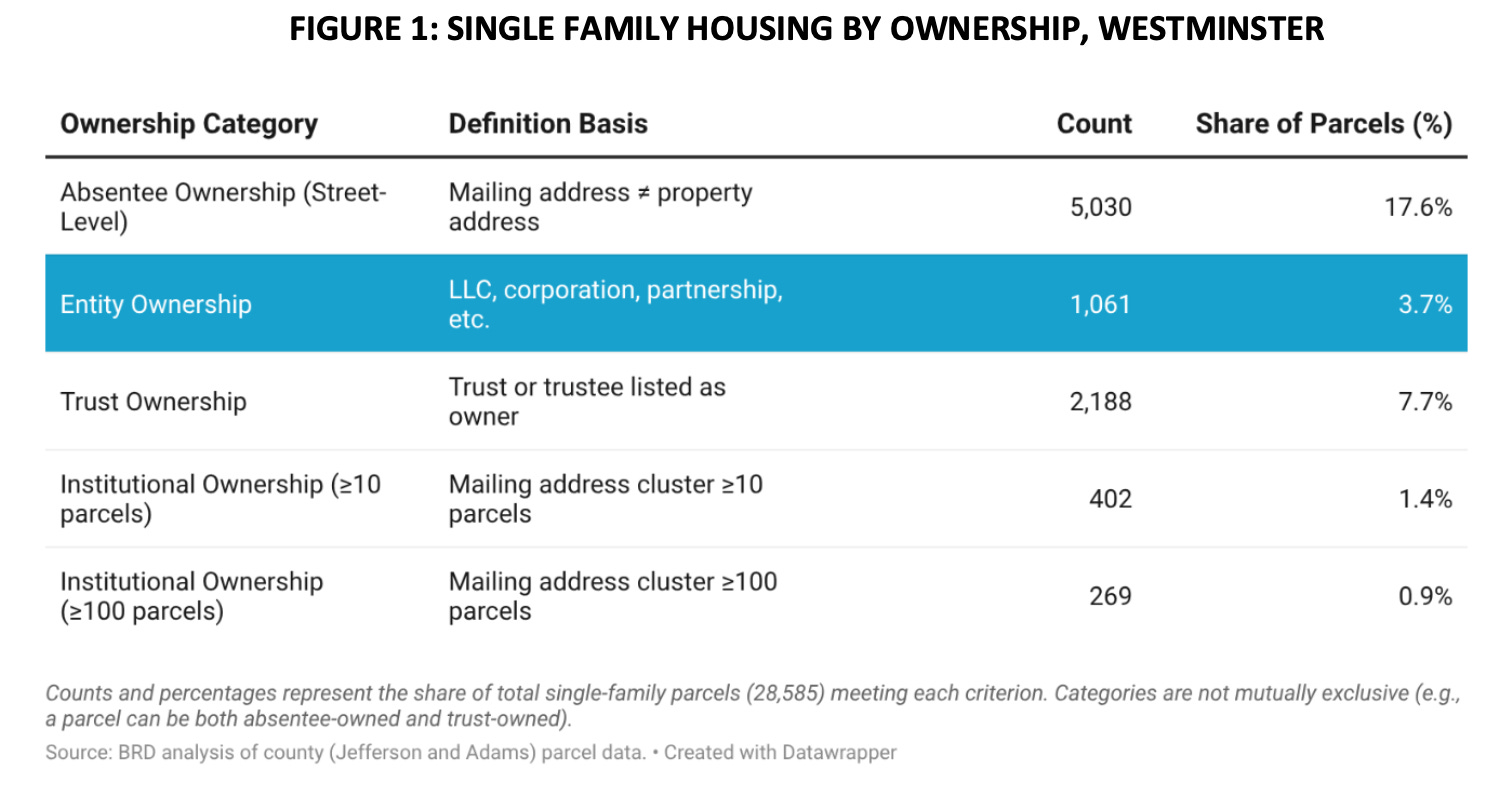
The test: In cities and suburbs across America, out-of-state corporations are purchasing housing stock at-scale and crowding out families and first-time buyers. In Dec 2025 I asked City staff to analyze the share of Westminster housing owned by non-individual investors (e.g. Corporations), including rental properties, out-of-state ownership, and owner-occupant purchases.
The data: Staff contracted with a research firm (University of Colorado Boulder) and submitted the results:
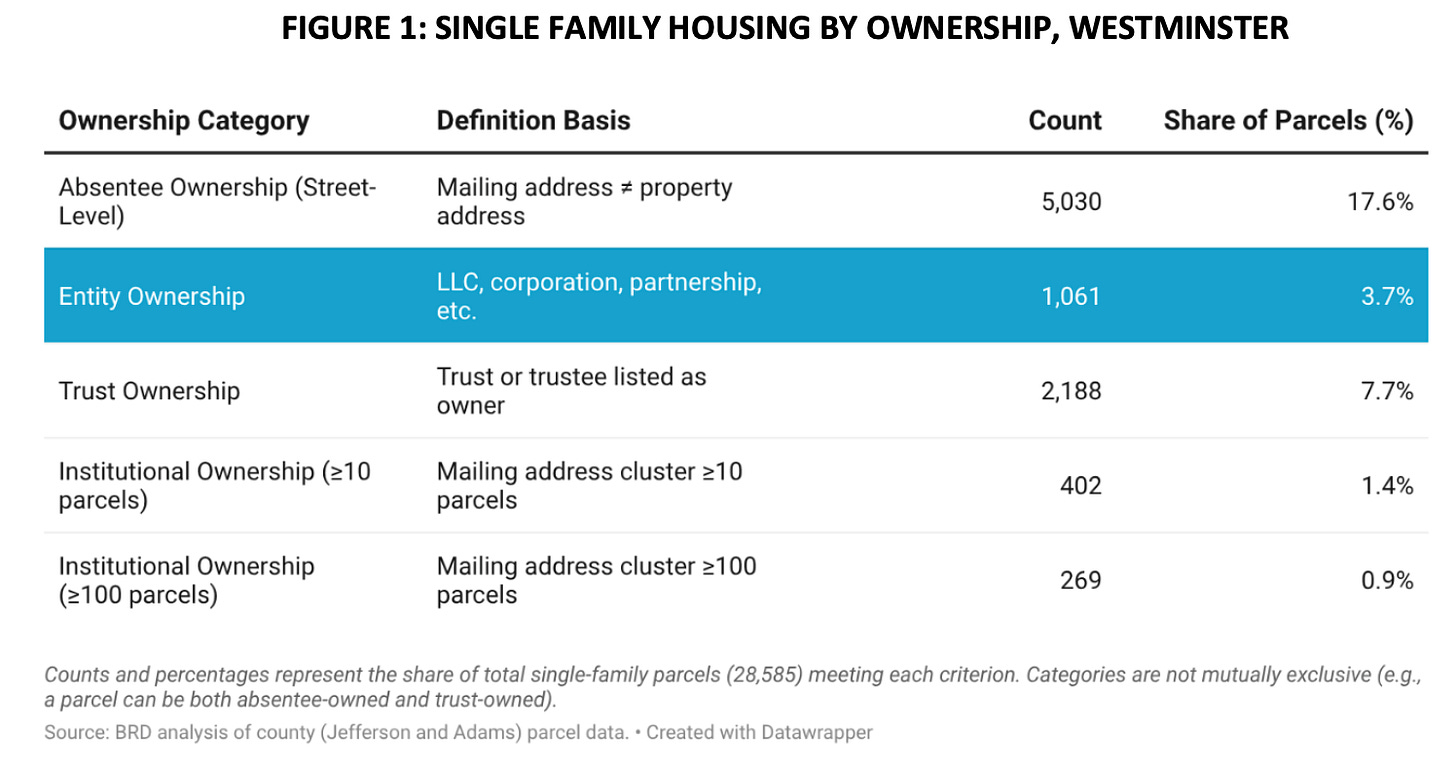
The decision: I’m formally requesting that we update the existing “Westminster Housing Needs Assessment” every 3 years to include ownership structure analysis quantifying non-individual investor ownership, out-of-state ownership, and investor participation in short-term rentals to inform affordability strategy, geographic targeting, and program design. Housing affordability is not just about supply and prices, it is also about who owns the housing. Across the country, non-individual and out-of-state investors are buying homes at scale and crowding out families and first time buyers. We cannot design effective affordability tools without knowing if that dynamic is happening here, where it is happening, and at what price points. Updating the Housing Needs Assessment every 3 years to include ownership structure data gives us an evidence based way to target down payment assistance, assess short term rental impacts, and protect owner occupancy without over regulating or guessing.

About Obi Ezeadi
Obi Ezeadi is a first-generation American, first responder (EMT) and City Councilor who champions economic, democratic, and personal freedoms for all of Westminster. He was recently re-elected to Westminster City Council with a record-breaking vote total and is prioritizing affordability in this final term. Obi came in as an outsider and delivered:
Expanded open space and parks
Expanded housing options (condos, townhomes, housing people can afford)
Made water more affordable and secured clean water for generations
Increased Mental health support
First-ever gun violence proclamation
First-ever Collective Bargaining Agreement for Police
Led best-in-class Firefighter Collective Bargaining Resolution and Enhanced Firefighter Collective Bargaining Agreement
Led the establishment of free transport service for seniors & disabled residents
Drove police vacancies down from a region-worst 13% to an area-leading 1%
Cut car thefts by 50%
Invested to solve unhoused crisis
Elevated transparency and accountability with our residents
I couldn't find a definition for "Residential Service Commitment Competition". Can you tell me what this was?