
If you missed it, see my previous newsletter:

Agenda
Important Announcements
“The Night George Read Made History” (2024 election turnout & engagement)
Deep-dive: 2025 Westminster City Budget
Announcements
Quick Update:
CPAT exam: I passed my CPAT (Candidate Physical Ability Test, first step to becoming a firefighter)!! I want to thank all of you for the outpouring of love - I felt your vibes! Onwards to Step 2.
New writing style: My essay below, “The Night George Read Made History,” experiments with a more vivid, narrative-driven approach to connect historical context to current events. I love crafting narratives, so I hope this resonates with you—let me know if it works or if you’d prefer a different style!
Events:
Hometown Christmas in Historic Westminster (12/6/24, 6:30PM-9:30PM @ Russell Park Honoring Firefighters): Celebration to include tree lighting, carols, vendor market, and hot chocolate.
Holiday Lighting Ceremony (12/7/24, 5:30PM-8:30PM @ Westminster City Hall): Countdown starts at 5:45PM.
The Night George Read Made History
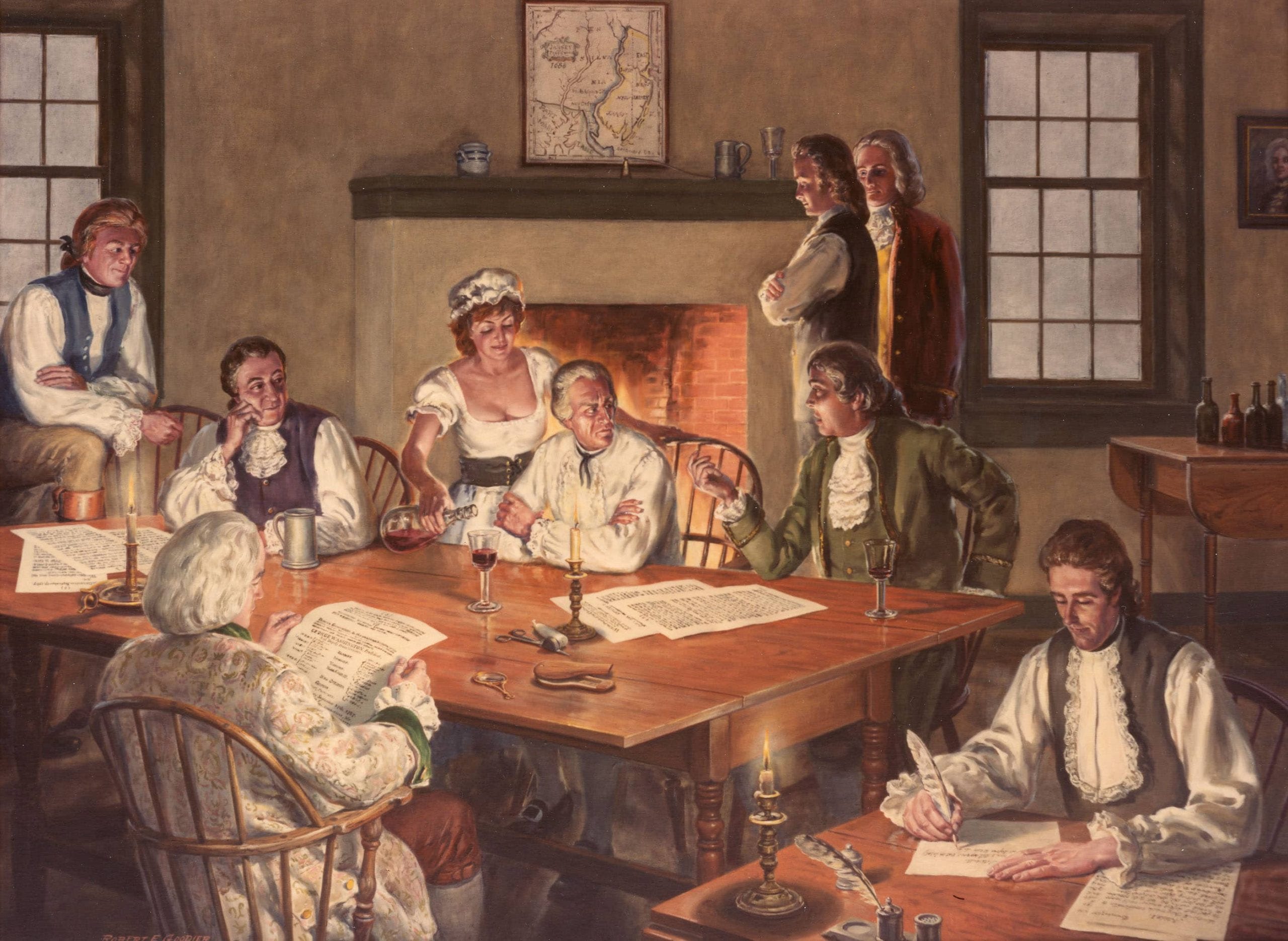
On this day, December 6, 1787, George Read sat in his Dover study, quill in hand, finalizing his arguments for what would become one of the most consequential decisions in American history.
As one of Delaware’s most respected legal minds and a former Continental Congress delegate, Read had long been an advocate for the union and an enduring critic of the Articles of Confederation. He knew that Delaware’s survival hinged on ratifying the newly proposed U.S. Constitution, a document he had worked tirelessly to support during its drafting just months earlier in Philadelphia.
The stakes were monumental.
Less than four months before, 37 of the 55 delegates at the Constitutional Convention in Philadelphia had signed the new framework of government, sending it to the states for ratification. By its own terms, the Constitution would become binding only when nine of the original 13 colonies approved it. Delaware’s leaders, fiercely protective of their small state’s sovereignty, knew the risks. If they hesitated, larger states might dominate the ratification process and leave Delaware voiceless. Read understood that being the first to ratify would not only secure Delaware’s equal footing but also set a tone of urgency for the other states.
That evening, as frost crept across the windows and the streets outside quieted, Read prepared for the next day’s convention. Delegates had been called to the Dover courthouse, a modest brick structure at the heart of the Green, to decide whether Delaware would lead the way. The significance of the moment wasn’t lost on Read. Ratification was about more than aligning with a new government—it was about survival and dignity for a small state surrounded by economic powerhouses like Pennsylvania and Maryland.
By sunrise on December 7, snow dusted the town as the 30 delegates convened. The Constitution was read aloud in its entirety, each word a reminder of the stakes and the complexities of governance. Debate followed, though it was brief. Months of Read’s careful persuasion had solidified a consensus. By noon, the vote was called, and the result was unanimous: Delaware ratified the U.S. Constitution, becoming the first state of the modern United States.
The courthouse bell rang out across the town, signaling the momentous decision. It was a declaration of existence, a defiant stand against the perception that small states could be marginalized. For the people of Delaware, the vote carried not just legal implications but a profound sense of pride and purpose. Read stepped out into the snow-covered square, surrounded by his fellow delegates. His demeanor was calm, almost reserved—this was not a moment for celebration but a resolute acknowledgment of the work ahead. Democracy was fragile, he knew, and it would require constant vigilance to sustain.
In Colorado’s November 2024 election, echoes of that resolute spirit were unmistakable. Across the state, 80% (3.2M) of active voters (4M) cast their ballots, with many braving a snowstorm to ensure their voices were heard. Jefferson County stood out, with 369,000 ballots returned and an impressive 83% turnout, reaffirming its reputation as a leader in electoral engagement. Despite challenges ranging from high early voting volumes to harsh weather, Jeffco completed its count faster than any other large Colorado county, underscoring the resilience of its election system and its voters. Similarly, Adams County achieved 80% turnout, Broomfield County 85%, Denver County 78%, Arapahoe County 78%, and El Paso County 77%. The rejection of (billionaire-funded) Proposition 131 underscored a collective belief that democracy should not be sold to the highest bidder but must reflect the will of the people.
Democracy is fragile, a truth as evident today as it was in 1787. It requires vigilance, participation, and an unwavering belief in its value. From the snowy streets of Dover to the ballot boxes of Jefferson County, the lesson endures: democracy doesn’t thrive by accident. It must be worked, protected, and nurtured—through quiet determination, collective action, and the steadfast resolve to ensure that every voice, no matter how small, matters.
Yours in service and hope,
Obi Ezeadi
Westminster City Council Member (at-large)
Stay updated in real time: Instagram
Civics 101: 2025 Westminster City Budget
Background
The cost of water bills burdens our most vulnerable residents in Westminster. In our 2025 budget, I’m proud to have championed the expansion of our Water Bill Assistance program. We significantly increased the bill assistance credit targeted to help those in need. Also, we are advancing critical projects like the new Municipal Court building and new drinking water facility. But, to understand how we arrived at the broader 2025 budget, let me take a step back and share the journey that shaped it.
First, on April 11, 2024, I published my annual strategic priorities for Westminster, focusing on public safety, housing affordability, reducing living costs, enhancing community health, revitalizing infrastructure, and empowering residents. These priorities, shaped by years-long conversations with working families and small businesses, were presented, along with priorities from other Councilors, during the City Council's strategic planning retreat on April 13. Subsequently, on May 6, 2024, the City Council adopted an updated Strategic Plan, thankfully incorporating many of my priorities and others. Westminster’s new Strategic Plan prioritizes opportunity, empowerment, health, vitality, and infrastructure, guided by principles of equity, sustainability, and innovation, to build a thriving Westminster.
Second, throughout the year, I actively engaged with residents, listened to their priorities, and collaborated with staff to ensure their ideas influenced the 2025 budget process. Other City Councilors also gathered their own community input throughout the year. Staff invited community members to propose projects, programs, or resource enhancements, carefully evaluating feasibility and costs before presenting them to City Council for final inclusion.
Then, on May 9, we achieved a significant milestone with the first-ever Budget Town Hall, a culmination of these efforts and the beginning of my personal aspiration towards participatory budgeting - a process shift that would further empower our 115,000 residents to shape Westminster’s future.
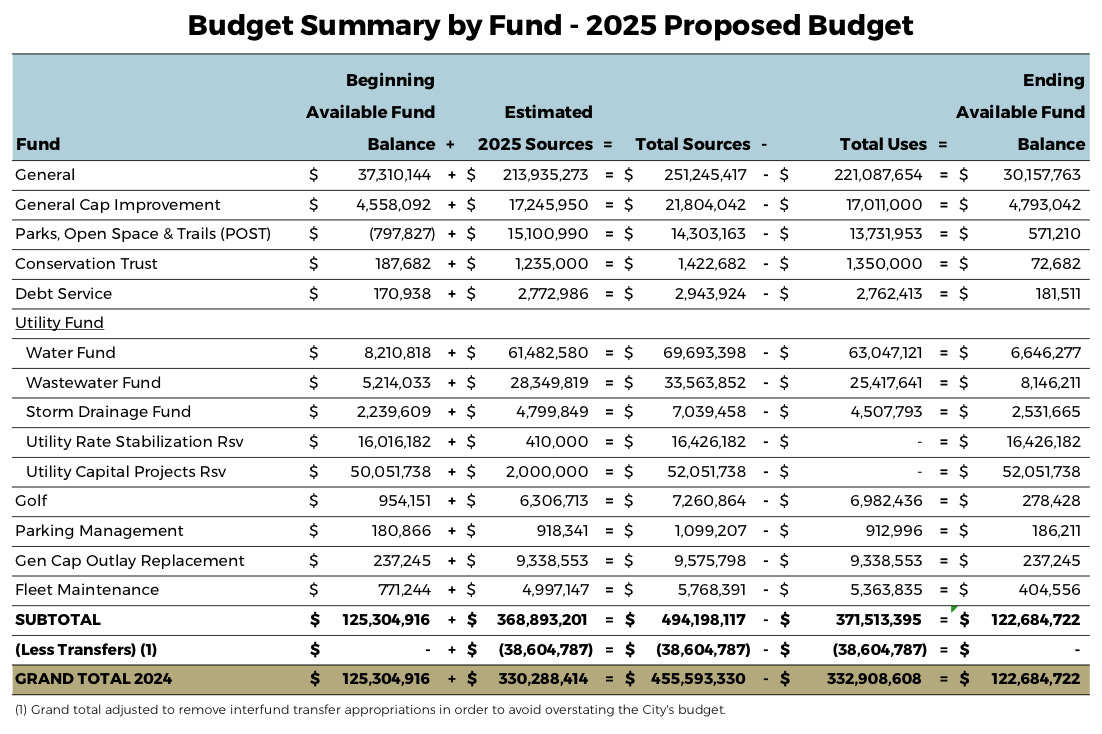
Westminster’s 2025 Budget is $372M
City Council approved the 2025 budget on 10/21/24:
Councilor’s Bill No. 31, passed on a 4-3 vote (Ezeadi, Hott, Carmelia, Nurmela): this Bill fully funds the Police Department, Fire Department, Streets Maintenance, Parks, Recreation and Libraries, and much more.
Resolution No. 26, passed on a 6-1 vote: this fully funds the 2025 Pay Plan for 1,125 full-time Westminster employees
Councilor’s Bill No. 32, passed on a 6-1 vote: this established water fee rates
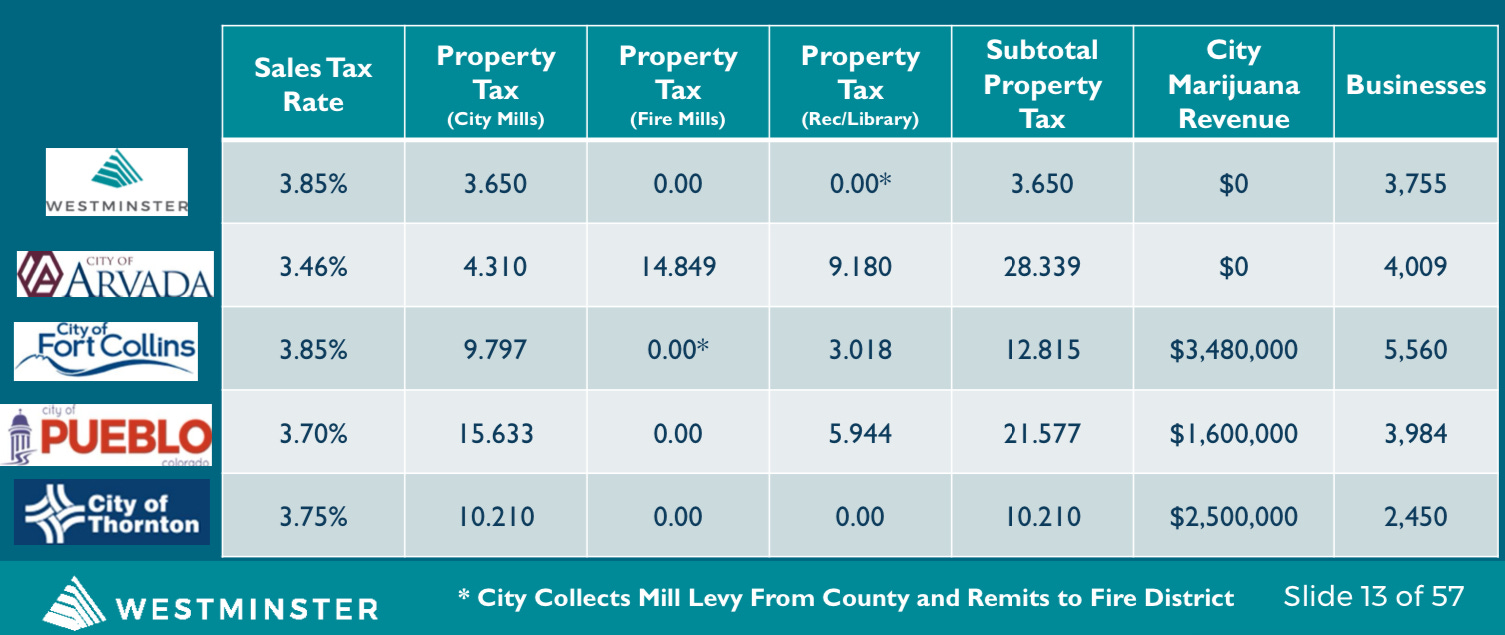
Resolution No. 27, passed on a 6-1 vote: this established the collectible mill levy (keeping it at 3.65)
Councilor’s Bill No. 33, passed on a 6-1 vote: authorized the appropriations for all the funds to pay for expenses
I am extremely proud of our 2025 Westminster budget, which prioritizes water affordability, open space, public safety, roads, infrastructure, mental health, housing, economic development, and community wellness.
The 2025 budget reflects rising service demands, higher costs of delivery, and the gap between general inflation, disposable income, and the unique costs of what the city provides. Sales and use taxes are projected to grow 6.1% in 2025, while we plan to continue to streamline city operations to save taxpayer dollars.
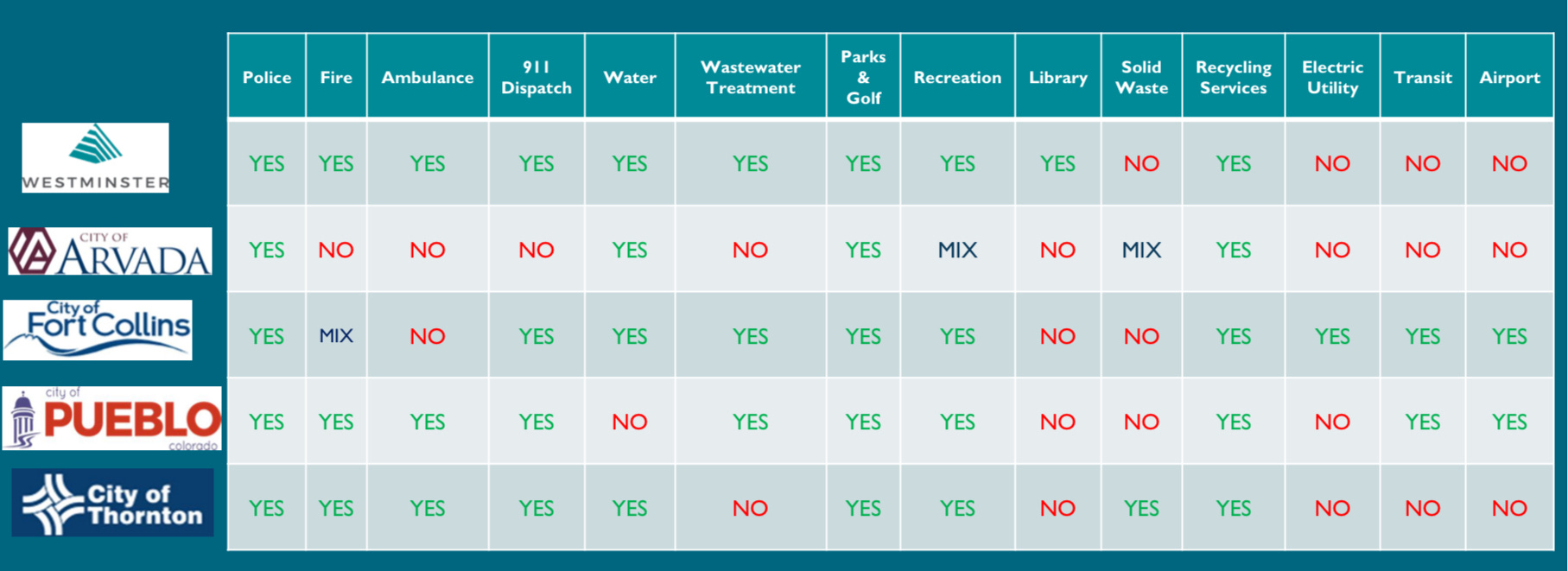
Westminster has 6,020 natural acres of parks and open space, 1,135 miles of roads, 3,755 businesses, 199 sworn police officers, a wide array of municipal services—all while having the lowest city portion of the property tax rate among peer cities, set at just 3.65 mills.
Some major highlights of the Capital Improvement Plan (CIP) budget:
Over $60M for Big Dry Creek Wastewater Treatment upgrades and sewer improvements over five years.
$14.6M in 2025 for road and concrete improvements, including $9.1M for arterials and $3M for concrete replacement.
$6.6M in 2025 for public safety and service vehicle replacements, including police cars, fire engines, and ambulances.
Nearly $8M for recreation enhancements over five years.
$1M for Rodeo Market renovations.
$5.5M reallocated from lower-priority projects and savings, funding initiatives like Q-Zone upgrades, Federal Parkway improvements, and multimodal projects.
Take a look at the full budget document here.
There is so much more about this budget to talk about. Ask me any questions you have.
“Government Unpacked” is a fact-based newsletter delivering deep dives on politics, history, and civics from a Colorado policymaker to help you unpack government and find your purpose to change the world.
Share it with a friend or neighbor. The better informed we are, the stronger our democracy.
🚨For Westy Residents: Bookmark these two important pages below🚨
Click: Important Westminster Events and Projects
On my newsletter’s homepage, I create a special, one-stop page that has information and links to everything you want to know about regarding (the important) Westminster events and major projects. All in one place.
Click: Obi’s Community Resources Master List
This page has a collection of links to important community resources related to water bills, housing, healthcare and more. If you know of a resource that should be added to this list, please email me to let me know!
Link to my full voting record.
Some ways I try to meet you where you are:
I hold weekly office hours (every Monday at 4:30PM at City Hall) - no appointment needed
Follow Obi on Instagram
Text or call me: 720-447-5606
Door-knocking (not for an election) to meet you where you are, connect you to resources and hear from you about issues I should prioritize
City Council Town Halls around the city