
I’ve been working to build a new model for local government that brings policy back to real life and expands the imagination of what a municipality can do for its residents, particularly around childcare, housing, groceries, and utilities.
Read Obi’s Childcare Policy Update here.
Read Obi’s Housing Policy Update here.
Today, let’s talk about groceries. Next week we’ll talk about utilities and the work we’re doing to tackle water rate affordability.
Alejandra and Cullen are residents who live on a 1.23 acre lot in Historic Westminster. They produce and sell fresh local eggs to neighbors at much lower prices compared to grocery stores. They want to provide more high quality, locally-produced eggs but current Westminster policy limits them to the same number of chickens as much smaller lots, even though they have significantly more land.
There are many residents with the same story. Government should never stand in the way of residents responsibly using their own land to feed their neighbors.
Grocery prices remain unaffordable and families are still feeling the cumulative effect of years of inflation. As egg prices continue to rise, genuinely free range and pasture raised eggs can cost $10 to $15 per dozen at nearby grocery stores, putting higher quality food out of reach for many residents.
This proposal would amend Westminster Municipal Code Section 6-7-12(I)(4) to scale the allowable number of backyard chickens based on lot size. The current ordinance allows six chickens on most residential lots under two acres and 12 chickens on lots of two acres or more. This proposal would allow six chickens per quarter acre scaling up to a maximum of 30 chickens on lots of 1+ acres.
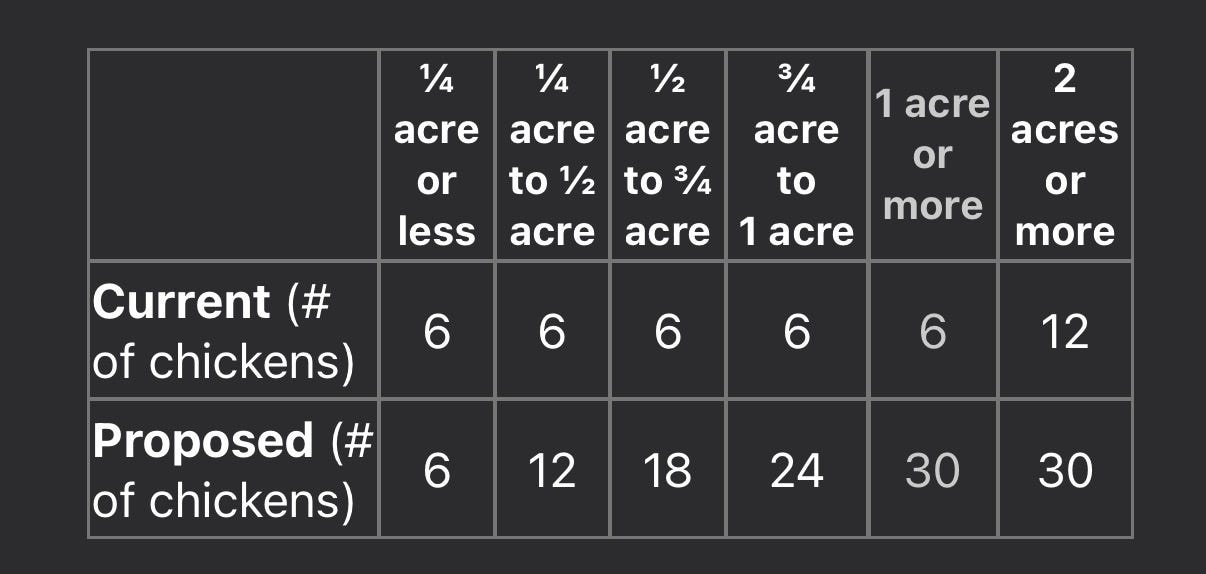
This change would better align allowable chicken counts with the amount of available land, improve community access to lower cost and healthier eggs, support local food production, and strengthen Westminster’s resilience to inflation, supply chain disruptions, climate pressures, and energy shocks.
Decentralizing egg production in Westminster is a small yet powerful way of impacting food affordability that gives residents more tools to feed their families and support their neighbors.
Tonight, I will be proposing this policy amendment to City Council and hopefully we may be able to vote on it by the end of the month.
About Obi Ezeadi
Obi Ezeadi is a first-generation American, first responder (EMT) and City Councilor who champions economic, democratic, and personal freedoms for all of Westminster. He was recently re-elected to Westminster City Council with a record-breaking vote total and is prioritizing affordability in this final term. Obi came in as an outsider and delivered:
Led integration of Childcare as essential infrastructure in Westminster’s Strategic Plan
Established zoning by-right for Childcare providers in 2040 Comprehensive Plan
Expanded open space and parks
Expanded housing options (condos, townhomes, housing people can afford)
Made water more affordable and secured clean water for generations
Increased Mental health support
First-ever gun violence proclamation
First-ever Collective Bargaining Agreement for Police
Led best-in-class Firefighter Collective Bargaining Resolution and Enhanced Firefighter Collective Bargaining Agreement
Led the establishment of free transport service for seniors & disabled residents
Drove police vacancies down from a region-worst 13% to an area-leading 1%
Cut car thefts by 50%
Invested to solve unhoused crisis
Elevated transparency and accountability with our residents
Would like Westminster to override HOA’s policies against owning chickens. TIA. :)
Thank you, Obi! I cannot be there tonight in support but having seen how these chickens are raised and cared for, and having eaten their eggs, I can say that their quality, taste and nutritional value are very high. It makes no sense to limit the nmber of chickens on an entire acre to the same as 1/4 of an acre. Increasing that limit will benefit the soil, control harmful bugs and produce more high quality eggs for the surrounding neighborhood. Being more mindful of the chicken to land ratio can only be a win/win!